Home  /  Site Info  /  Feedback Form  /  Terms of Use / Privacy Policy
Our Video Clips  /  Calendar Directory  /  Calendar Store   /  Blogger  /  Send Greeting Cards  / Thank You!

Copyright 2004 & Up / Gone-ta-pott.com - All rights reserved.
Monthly Holidays
January  /  February
March  /  April  /  May
June  /  July  /  August
September  /  October
November  /  December

Types of Holidays
Federal Holidays
Federal Observance
Hallmark Holidays
International Observ
Movable Feast
Major Holidays
Movable Holidays
Nationwide Observ
Proclamation Holidays
State Holidays
Types of Holidays
Unofficial Holidays

Holiday Categories
Animal Holidays
Career Holidays
Craft&Hobby Holidays
Dance Holidays
Drink Holidays
Environmental
Food Holidays
Fruit Holidays
Game Holidays
Garden Holidays
Health Awareness
Literature Holidays
Personality Holidays
Religious Holidays
Romantic Holidays
Spooky Holidays
Supernatural Holidays
Weird Holidays

Popular Holidays
Easter
Christmas
Mother's Day
Father's Day
Thanksgiving
Valentines Day
St. Patrick's Day
Halloween Home

Calendar Related
Astronomy
Birthstones / Month
Daylight Saving Time
Flower of the month
Friday the 13th
Full Moon Day
Zodiac Signs
The Four Seasons
Todays Birthday
Horoscope

Be Entertained
Games
Today In History
Recipe-of-the-day
Trivia Tournament
Daily Bible Verse
Joke of the Day
Fun Page Exchange!

  Name Days!
New to Name Day Celebrations? What is Name Day?
"A name day is a tradition in many countries in Europe and Latin America of celebrating on a particular day of the year associated with the one's given name. The custom originated with the Catholic and Orthodox calendar of saints, where believers, named after a particular saint, would celebrate that saint's feast day. In many countries, however, there is no longer any explicit connection to Christianity."

Wiktionary Defines it as:
The feast day of the saint after whom one is named.

History
"The celebration of name days has been a tradition in Catholic and Orthodox countries since the Middle Ages, and has also continued in some measure in those countries, such as England and the Scandinavian countries, whose Protestant established church retains certain Catholic traditions. The name days originate in the list of holidays celebrated in commemoration of saints and martyrs of the church. For example, the name Karl or Carl is celebrated in Sweden on January 28, the anniversary of the death of Charlemagne (Charles magnus, i.e., 'the great'). The church promoted celebration of name days (or rather saints' feast days) over birthdays, as the latter was seen as a pagan tradition."

"Where name days occur an official list is held containing the current assignations of names to days. There are different lists for Finnish, Swedish, Sami, and other countries that celebrate namedays, though some names are celebrated on the same day in many countries. From the 18th century and onwards the list of name days has been modified in Sweden and Finland, but not in other countries."

Name days in various countries

Bulgaria:  Name days in Bulgaria
"Name days in Bulgaria are associated almost always
with Bulgarian Eastern Orthodox celebrations. Some
names can be celebrated on more than one day and
some have even started following foreign traditions
(like Valentina being celebrated on the Catholic St.
Valentine's day."

"Name days in Bulgaria are important and widely
celebrated. By an ancient Bulgarian tradition,
everybody is welcome on name days; there is no need
to invite guests. Presents are not given."

Common well-wishes include "may you hear your
name from grandchildren and great-grandchildren"
and "may you hear your name only in good things".
__________________________________________

Czech Republic:   Name days in the Czech Republic
"In the Czech Republic, each day of the year
corresponds to a personal name (or several names).
People celebrate their name day (svátek or more
formally jmeniny) on the date corresponding to their
own given name."

"Name days are commonly of less importance than
birthdays to Czech people. However, name day celebrations can be, and often are, held together with friends or co-workers of the same name and in this way it can grow in size and importance."

"In the past, by law, parents were not allowed to choose just any name for a child. This has changed, although it is still common to choose the name from the name day calendar. The original list was the Roman Catholic calendar of saints, but changes have been made to reflect the present-day usage of names."
______________________________________________________________________________

England
"The most important name day in England is St. George's Day - 23 April. St. George is the Patron Saint of England."

"Names are not restricted to any official list, parents may choose any name they like. This means that not everyone will have a name day. Birthdays are usually considered much more important than name days. Possibly because of an influx of many Polish immigrants, the name day tradition has increased."

"A modern source of English name days that is based around Saint's days can be found on the
happy name day website."
______________________________________________________________________________

Finland
"Today Finns celebrate their name days (or nimipäivä) according to their given name on the date given by the calendar published by the University of Helsinki Almanac Office (Almanakkatoimisto). Every day except New Year's Day, Christmas Day, and February 29 is a name day. For each day there are names in both Finnish and Swedish; the names are frequently, but not always, cognates."

"Women are slightly underrepresented in the calendar: approximately 45 per cent of name days celebrate only women while some 49 per cent are name days of men. The rest are those of names that may be given to either sex, such as Rauni (July 15), or have both a man's and a woman's name, such as Oliver and Olivia (May 29)."

"Many traditional beliefs attach to various name days, especially involving the weather and the appropriate times to perform seasonal agricultural tasks such as planting some particular crop. For example there is a saying that "Jaakko (James) casts a cold rock into the water", meaning that on Jaakko's day, the 25th of July, the waters start getting colder, which is not far from true on average. The seven days from July 18 to 24th, being all women's name days, are known as the women's week. It is popularly believed to be an especially rainy week, and this is to some extent supported by statistics, as late July and early August are the rainiest time of the year in Finland."

"The Almanac Office reviews the lists every year, adding new names as they gain popularity and striking others that have faded into disuse. The university owns the copyright to the lists of names and their corresponding dates."

"The Finnish Orthodox Church has its own calendar of name days, corresponding to the feasts of Orthodox saints."
______________________________________________________________________________

Greece
"In Greece and Cyprus, a name day (Greek: εορτή, eortē, or γιορτή, yiortí, "feast") is celebrated in a similar way to a birthday."

"According to the Orthodox Church, every day of the year is dedicated to the memory of at least one (usually more than one) saint or martyr. If someone is named after a saint, then there is a big celebration on his or her name day. In Greece and Cyprus many names derive from long pagan tradition, and there may not be a Christian saint by the same name. In such a case the person is said "not to have" a name day, or they may choose to celebrate on All Saints' Day. The vast majority of name days are on the same date every year; the few exceptions are names directly or indirectly associated with Easter, and are floating. This facilitates social interaction, as all Greek language calendars include detailed name day lists. Some name days coincide with major Christian feasts, for example people whose names are Chrēstos or Christine have their name day on Christmas, people named after St. Basil have their name day on New Year's Day, Anastásios and Anastasía on Easter Sunday, María and Mários on the Dormition or on the Presentation, etc."

"The traditional format of a name day celebration is an open house: no specific invitations are extended and all well-wishers are welcomed. This is not uniformly observed: a family or person may choose to celebrate with invited guests only, at home, at a restaurant, a bar or a club, or not celebrate at all (e.g. following a recent bereavement). Name day celebrations are similar to birthdays, except for expected differences (e.g. there is no cake with candles on a name day). Children celebrate their birthdays and name days equally festively; as the person grows up the emphasis shifts decisively to the name day and birthdays become lower-key, family affairs."

"Entertainment provided by the celebrating host may include formal or informal meals, drinks, desserts, music, dancing, etc. It is the person being celebrated that arranges the party and serves the guests, instead of the guests fussing over the celebrant. It is poor form for a guest to arrive at such a celebration "empty-handed", although the gift offered may be something as financially trivial as a card or a few flowers. Money gifts are also considered poor form, except if the celebrant is a child or teenager and the gift is offered by an adult relative or a godparent. It is poor form to celebrate birthdays and name days in too grand a fashion if the two days are close to each other. In such cases the celebrations are best merged. It is also common to shift a name day celebration to the following Friday or Saturday evening if a dinner party is planned."
______________________________________________________________________________

Hungary:  Name days in Hungary
"Name days (in Hungarian: névnap) in Hungary are very popular, often as much as a person's actual birthdate. A woman is typically given flowers on her name day by acquaintances, including in the workplace, and the price of flowers often rises around the dates of popular names because of demand. A bottle of alcohol is a common gift for men on their name day. Name days are more often celebrated than birthdays in workplaces, presumably because it is simpler to know the date since most calendars contain a list of name days. Children frequently bring sweets to school to celebrate their name days. Some highly popular names have several name days; in that case, the person chooses on which day he or she wishes to celebrate.
______________________________________________________________________________

Latvia
"In Latvia, name days (in Latvian "vārdadienas") are settled on certain dates; each day (except for February 29 in leap year) is a name day. Usually Latvian calendars list up to four names each day - around 1,000 names a year. Recently an extended calendar with around 5,000 names was published, and there are also a few extended calendars found on the Internet listing names even on February 29. February 29 is a popular date to celebrate name days of people who do not have a name day; another such date is May 22. People who do not have name days in ordinary calendars can enjoy many variations when to celebrate - on February 29 or May 22 and, if they have their name in an extended calendar or in the church calendar, on the date listed there (so in leap year such a person can choose from 2 to 4 dates when to celebrate). The Latvian name days calendar is updated at one or two-year intervals; anyone can suggest a name for the calendar, usually by sending an application to the State Language Centre ("Valsts valodas centrs")."

"Celebrations are quite like birthday celebrations. It is popular to celebrate name days in one's workplace - usually the one that has a name day prepares snacks for well-wishers, and during the day colleagues arrive one after another with flowers, sweets and small presents to greet him. Sometimes, especially in smaller companies, a certain time is set for the main celebrations. It is normal to come to a name day celebration without an invitation. At school one is expected to arrive with candy for classmates and teachers. Celebrating name days at home is not as popular as celebrating a birthday, although it may vary depending on the period of time between one's birthday and name day; usually one will eat cake with household members and receive presents."
______________________________________________________________________________

Poland:  Name days in Poland
"In Poland, name days (Polish: imieniny) are widely celebrated, and most calendars contain the names celebrated each day. Name day celebrations in Poland traditionally involve a gathering of friends and family at the celebrant's home at the dinner table, followed by drinking and socializing, similarly to birthday celebrations. Child celebrants, and often adults too, receive presents, just like on their birthday.
______________________________________________________________________________

Russia
"In Russia, name days (именины (imeniny) in Russian) have been celebrated apart from birthdays. Some calendars contain name days, but usually one must buy a special name day calendar. Celebrations range from cards and flowers to full-blown celebrations similar to birthday parties. Such a celebration begins with attendance at the divine services marking that day (in the Russian tradition, the All-Night Vigil and Divine Liturgy), and usually with a festive party thereafter. Before the October Revolution, the name day was considered as important as, or more important than, the celebration of the birthday. The rationale for this importance is that one's baptism is the event by which they are "born anew" in Christ. In modern times, however, few people know the traditions associated with it."

"One of the most popular references of a Russian name day is the entire first act of Anton Chekhov's Three Sisters, where Irina is celebrating her name day."
______________________________________________________________________________

Scandinavia
"During medieval times name days were of little significance in the Nordic countries, except for the celebration of patron saints for various guilds. A more widespread celebration of name days began in the 17th century, at first in the royal court and among aristocracy, but successively also among the general population. The Church of Sweden promoted celebration of name days over birthdays, as the latter was seen as a pagan tradition.
______________________________________________________________________________

Slovakia:  Name days in Slovakia
"In Slovakia name days are widely celebrated. Also celebrations in workplace, or school are commonplace. Celebrations at school are different than those in family, the celebrant gives candies to his or her classmates. Flowers are sometimes sold out for popular name days. In the past, by law, parents were not allowed to choose just any name for a child. This has changed, although it is still common to choose the name from the name day calendar. The original list was the Roman Catholic calendar of saints, but changes have been made to reflect the present-day usage of names."
______________________________________________________________________________

Slovenia
"Name days (called god, n., m., sing.) were widely celebrated, and preferred over birthday celebrations, until after WW II and the advent of Communism. In rural areas as well as among certain strata of town people the custom of celebrating name days lasted longer. Nowadays, while the tradition has not been completely obliterated, name days are celebrated mostly among older people."
______________________________________________________________________________

Spain and Latin America
"Until recently, name days in Spain and Latin America (called onomásticas or día de mi/su santo) were widely celebrated and had more importance than birthday celebrations. Onomásticas are not limited to saints but also include the celebration days of the different representations of the Virgin Mary. For example, the name day of a woman named Carmen would be July 16, day of our Lady of Mount Carmel. Currently, onomásticas are still remembered in more traditional families but are not generally celebrated with festive parties and presents as they were in the past. To celebrate name days, practicing Catholics typically attend mass and have some intimate family celebration."
______________________________________________________________________________

Sweden:  Name days in Sweden
"From the 18th century onwards, names used by the royal family were introduced to the Swedish list of name days, followed by other common names. In 1901 a comprehensive modernization was made to make the list up to date with current names. The monopoly on almanacs, held by the Royal Swedish Academy of Sciences, expired in 1972 and so did the official name day list. Competing name day lists began to emerge but the official list was still in general use until 1986 when consensus of a new list with three names on each day was reached. This list was revised in 1993 and reduced to two names on each day. However, widespread dissatisfaction with the list prompted the Swedish Academy to compile a new two-name list which was finally accepted and brought into use in 2001. Although it does not have the official status of the 1901 or older lists, it is now universally used in Sweden.
______________________________________________________________________________

USA
"The particular mix of cultures in the USA means that a wide variety of name days are celebrated. Many people rely on the name day calendar of their ancestor's country of origin, others rely on a variety of name day calenders, many of which don't follow the basic premise of a name day: The feast day of the Saint after whom the person is named. These calendars are based around celebrity or ex-president's names and don't form a lasting basis for celebration."

"A modern source of English name days that is based around Saint's days can be found on the
happy name day website." (Name days for 18 countries by date)
______________________________________________________________________________

See Also:

External links

Shop:
Cookbook Store / Bread Baking Store / The Wooden Kitchen / Cookie Baking Store
Cookie Baking Store & hard to find Cookie Cutters / Pie Baking Store / Coffee Store /AStore?

Resources: This article is licensed under the GNU Free Documentation License. It uses some material from Wikipedia/article  namedays/and other related pages. Top Photo: homestead stock -  Middle Photo: almanac
Food Holidays
Common Meals
BreakfastSecond BreakfastBrunch
Champagne BreakfastLunchDinner  • Supper
Tea (meal): Afternoon TeaHigh Tea
Holiday Related to "Name Days"
"Celebrate Your Name Week is a holiday established in 1997 by which the first full week in March as a week for everyone world-wide to embrace and celebrate his or her name." This week is also a week to be reminded what "Name Days" are as well-
Related Pages!
Zodiac Signs / Horoscope / Birthstones of month
Flower of the month / Your Birthday Flower
Birthday / Todays Birthday / Birthday Party
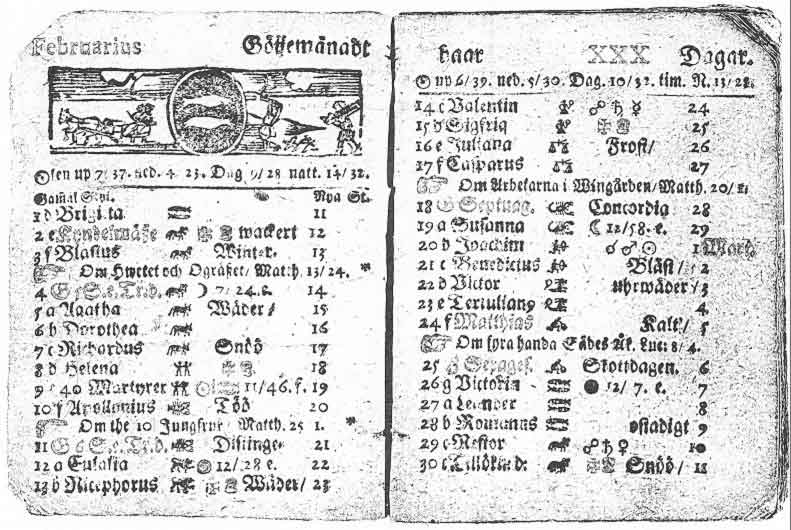
The picture shows two pages from a Swedish almanac from 1712. In the top left corner you see the word "Februarius", and at the bottom of the right page, the 30th day of that month is mentioned.
The two words to the right of the number "30" are:


     By the rest of the dates, the Swedish name day names are listed. To the right of February 14 it says Valentin, Swedish for en:Saint Valentine.
A look into Name Related Holidays
Namesake Day / Name Fun Facts Day
Name Tag Day / Learn What Your Name Means
Unique Names Day / Celebrate your name week
Genealogy Day / Candles on a Cake Day /
Middle Name Pride Day
Gone-ta-pott.com
Gone-ta-pott.com
"Your Holiday Directory"