When is National Danelion Day? Always April 5th!
Origin of this Holiday
Our research did not find the creator, or the origin of this day. We did however find that this holiday has been celebrated for years. There is plenty of documentation to support that National Dandelion Day" does indeed exist.
We are wondering if this holiday was created by a flower organization- but, our research couldn't find the creator-
This holiday is referred to as a "National" day. However, we did not find any congressional records or presidential proclamations for this day. Even though we didn't, this is still a holiday that is publicized to celebrate.
So have fun with it and celebrate it!
We found recognition about this holiday from:
Calendar sites and personal Internet sites that blog and share information about this holiday.
________________________________________________________________________
Antioxidant properties: "Dandelion contains luteolin, an antioxidant, and has demonstrated antioxidant properties without cytotoxicity."
Caffeic acid and carcinogenicity: "Caffeic acid is a secondary plant metabolite produced in dandelion, yarrow, horsetail and whitethorn. Despite its name, it is unrelated to caffeine. Recent studies have revealed this acid may be carcinogenic (However, other studies appear to say it's anti-cancer. See Wiki page on caffeic acid for details.). When caffeic acid was tested for carcinogenicity by oral administration in mice, renal cell adenomas appeared in females, and a high incidence of renal tubular cell hyperplasia occurred in animals of each sex. However, more recent research shows that bacteria present in the rodents' intestines may alter the formation of metabolites of caffeic acid. There have been no known ill effects of caffeic acid in humans."
Bees: "Dandelions are important plants for bees. Not only is their flowering used as an indicator that the honey bee season is starting, but they are also an important source of nectar and pollen early in the season."
Pearl bordered Fritillary: "They are also used as a source of nectar by the Pearl-bordered Fritillary (Boloria euphrosyne), one of the earliest emerging butterflies in the spring."
"Dandelions are used as food plants by the larvae of some species of Lepidoptera (butterflies and moths). See List of Lepidoptera that feed on dandelions."
"Away from their native regions, some dandelion species have become established in the Americas, Australia, and New Zealand, and are now common throughout all temperate regions, Taraxacum officinale has become a nearly world wide weed."
_______________________________________________________________________
The species of Taraxacum are tap-rooted biennial or perennial herbaceous plants, native to temperate areas of the Northern Hemisphere of the Old World.
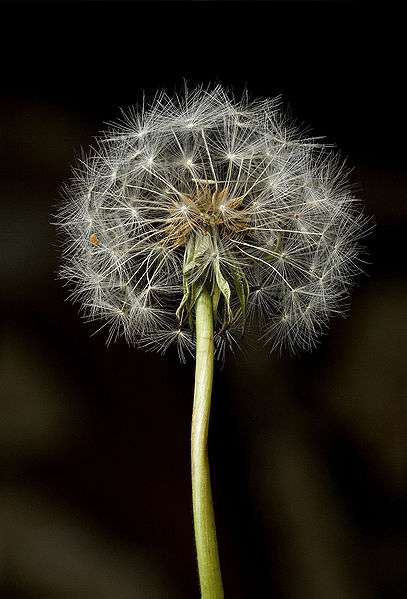
"The leaves are 5-25 cm long or longer, simple and basal, entire or lobed, forming a rosette above the central taproot. The flower head, are yellow to orange colored, and are open in the daytime but closes at night. The heads are borne singly on a hollow stem (scape) which rises 4-75 cm above the leaves and exudes a milky sap (latex) when broken. A rosette may produce several flowering stems at a time. The flower heads are 2-5 cm in diameter and consists entirely of ray florets. The flower heads mature into a spherical "clocks" (also known as a "wishie") containing many single-seeded fruits called achenes. Each achene is attached to a pappus of fine hairs, which enable wind-aided dispersal over long distances. The flower head is surrounded by bracts (sometimes mistakenly called sepals) in two series. The inner bracts are erect until the seeds mature, then flex downward to allow the seeds to disperse; the outer bracts are always reflexed downward. Some species drop the "parachute" from the achenes; the hair-like parachutes are called pappus, and they are modified sepals. Between the pappus and the achene, there is a stalk called a beak, which elongates as the fruit matures. The beak breaks off from the achene quite easily, separating the seed from the parachute."
_______________________________________________________________________
Resources: